
Why Source Butterfly Pea Powder for Your Business?
In practical ingredient sourcing, consistency often matters more than colorful promises. Butterfly Pea Powder can give beverages, desserts, bakery products, and wellness-inspired menus a distinctive blue tone. Its color comes from naturally occurring anthocyanin compounds in butterfly pea flowers. However, the final shade may vary with origin, drying methods, pH, storage, and processing conditions. That detail deserves attention.
A reliable supplier should provide clear product specifications, including botanical identity, mesh size, moisture level, packaging format, and recommended storage conditions. Ask for current certificates of analysis and relevant microbiological testing. Heavy metal, pesticide, and allergen information may also support responsible purchasing decisions. Documentation is not decoration. It helps buyers compare suppliers and reduce avoidable quality risks.
Good sourcing also requires practical testing. Request a sample before placing a large order. Mix a measured amount into water, yogurt, frosting, or a beverage base. Observe color intensity, aroma, solubility, sediment, and batch consistency. Acidic ingredients may shift the blue color toward purple or pink. That visual change can be useful, but it must match your product design.
Price alone can mislead.
A lower quotation may reflect weaker testing, inconsistent materials, or unsuitable packaging. Experienced buyers should evaluate lead times, minimum order quantities, traceability, and communication quality together. No supplier is perfect, and even a well-reviewed product needs verification. By combining laboratory documentation with small-scale trials, businesses can make a more confident decision about sourcing Butterfly Pea Powder for dependable commercial use.
What Is Butterfly Pea Powder and Where Does It Come From?
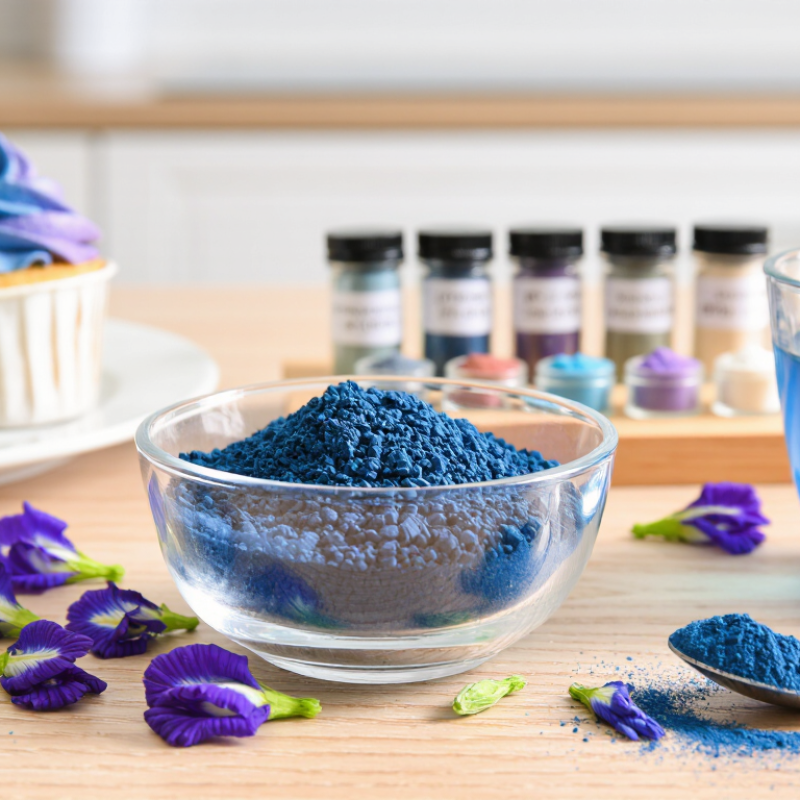
Butterfly pea powder is made from the dried flowers of Clitoria ternatea, a climbing plant in the pea family. Its vivid blue color comes mainly from anthocyanins, natural pigments that respond to acidity. Add lemon, and the drink may shift toward purple. The effect is striking, but color strength is not fixed. Flower maturity, drying temperature, and storage conditions can all change the final shade.
The plant is associated with tropical Southeast Asia, where it has long appeared in traditional drinks and food preparations. Today, growers also cultivate it in other warm regions with suitable rainfall and soil. After harvest, flowers should be sorted, cleaned, gently dried, and milled into a fine powder. Poor drying can leave excess moisture and weaken aroma. That detail is easy to overlook. The powder is not automatically uniform.
For a business buyer, origin is only one part of a reliable source. Ask for the botanical name, cultivation country, harvest information, processing details, and batch testing. Useful checks include moisture, microbial quality, contaminants, pesticide residues, and color consistency. A certificate alone does not prove every batch is identical. Sampling matters. Suppliers should explain packaging, shelf life, and storage needs clearly. A cool, dry, light-protected environment usually helps preserve quality. Do not judge the ingredient by appearance alone; vivid blue powder may still lack traceability. Conversely, a softer shade is not automatically a defect.
Why Is Butterfly Pea Powder Valuable for Business Use?
Butterfly pea powder is valuable for business use because it offers a vivid blue color from a plant-based source. Food and beverage developers can use it in teas, drink mixes, desserts, bakery items, and functional-style products. Its mild flavor usually allows other ingredients to remain prominent. That flexibility helps create visually distinctive products without relying on artificial-looking colors.
In practical formulation work, color performance depends on pH, heat, light, and storage conditions. Acidic ingredients may shift the color toward purple or pink. That change can be attractive, but it must be controlled. Consistent powder quality also matters. Particle size, moisture level, purity, and microbial testing can influence production results. Suppliers should provide clear specifications, batch documentation, allergen information, and compliant food-grade records.
The powder can support premium positioning through simple visual experiences. Imagine a blue iced drink changing color after citrus is added. Small details like this may encourage customer interaction and social sharing. However, it is not a magic ingredient. Strong claims about wellness or performance require reliable evidence and careful regulatory review. I have seen promising concepts weaken because color stability was tested too late. A better approach is to test the powder in the final recipe, packaging, and expected storage conditions. Some formulas may still need adjustment. That is part of responsible product development.
Why Source Butterfly Pea Powder for Your Business?
Butterfly pea powder is valued for its naturally vivid blue color, anthocyanin content, caffeine-free profile, and pH-responsive color change. The index below rates documented product characteristics on a 1–5 business relevance scale.
Score interpretation: 1 = limited relevance and 5 = strong relevance for product development. The assessment reflects commonly documented botanical characteristics, not company sales data or market-share statistics. Actual color strength and composition may vary by cultivar, harvest, processing, and supplier specifications.
How to Evaluate Butterfly Pea Powder Quality and Safety
Why Source Butterfly Pea Powder for Your Business?
Quality evaluation should begin before the powder reaches your warehouse. Butterfly pea’s blue color comes from anthocyanins, but color intensity alone cannot prove authenticity. Request a lot-specific certificate of analysis, not a generic document. It should show botanical identity, moisture, microbiological results, heavy metals, pesticide residues, and anthocyanin content. Ask for the testing method and laboratory accreditation. Details matter.
Check the powder in real conditions. Observe its color, aroma, particle size, and behavior in water. A clean sample should disperse consistently without an unusual odor, excessive sediment, or unexplained color changes. Test several lots, because one attractive sample proves little. It sounds obvious.
The World Health Organization estimates that contaminated food causes about 600 million illnesses and 420,000 deaths globally each year. This reinforces the need for preventive controls, not visual inspection alone. Codex General Principles of Food Hygiene, revised in 2022, recommends risk-based controls across the food chain. ISO 22000:2018 also emphasizes traceability and hazard management. Choose suppliers who can provide harvest records, processing details, sealed packaging, and recall procedures. I would also verify storage temperature and humidity during shipping. This step is often neglected. A perfect certificate cannot correct poor handling. Some specifications may need refinement after pilot production, especially when acidity, heat, and light affect the final shade. Reliability is built through repeated evidence, not confident promises.
Which Industries and Products Use Butterfly Pea Powder?
Butterfly pea powder is used across several industries, especially food and beverage manufacturing. Beverage companies add it to herbal teas, lemonades, smoothies, and powdered drink blends. Its vivid blue color can shift toward purple when mixed with acidic ingredients. This creates an engaging customer experience.
Bakeries and confectionery producers use the powder in frostings, macarons, noodles, candies, and dessert sauces. Small amounts can tint products without creating a heavy flavor. However, heat, moisture, and storage conditions may affect the final color. Testing a sample batch is essential. The result is not always perfectly blue.
Cosmetic manufacturers may include butterfly pea powder in masks, soaps, and botanical body products. These applications require careful ingredient checks, clean processing, and suitable packaging. Businesses should request botanical identification, microbiological results, heavy metal testing, and batch traceability from suppliers. I have found that consistent particle size also improves mixing during production. Yet powder quality can vary between harvests, so one successful trial does not guarantee every future batch. Clear specifications and repeat testing support more reliable sourcing.
Why Source Butterfly Pea Powder for Your Business? - Which Industries and Products Use Butterfly Pea Powder?
| Industry | Common Product Formats | Why Butterfly Pea Powder Is Used | Relevant Functional Characteristics | Key Sourcing Considerations | Typical Quality Checks |
|---|---|---|---|---|---|
| Beverages | Tea blends, powdered drink mixes, smoothies, lemonades, mocktails and ready-to-mix beverages | Provides a naturally blue color and supports visually distinctive beverage concepts | Anthocyanin pigments are pH-sensitive; acidic ingredients can shift the color toward purple or pink | Solubility, color strength, flavor profile, particle size and stability in the intended beverage system | Color value, moisture, microbiological status, heavy metals, pesticide residues and dispersibility |
| Bakery and Desserts | Cakes, cookies, macarons, frostings, icings, puddings, jellies and decorative fillings | Adds plant-based color to finished products and can support premium visual positioning | Color may be affected by heat, light, oxygen and recipe acidity; performance depends on the formulation | Thermal stability, compatibility with fats and sugars, color retention after baking and batch consistency | Moisture, microbial limits, color uniformity, foreign matter and bake-test performance |
| Confectionery | Hard candies, gummies, jellies, marshmallows, chocolate decorations and powdered toppings | Offers a botanical color option for visually appealing sweets and novelty products | Color expression varies with pH, sugar concentration and processing temperature | Compatibility with gelatin or pectin systems, color stability, taste neutrality and flowability | Color dosage, moisture, microbial testing, particle size and absence of artificial additives when required |
| Dairy and Plant-Based Alternatives | Yogurt, frozen desserts, milk alternatives, puddings and flavored cultured products | Creates blue, violet or purple visual effects in chilled and frozen formulations | Acidity, protein content, light exposure and storage temperature can influence color stability | Dispersibility in aqueous systems, sensory neutrality, freeze-thaw behavior and storage stability | pH compatibility, microbial limits, color retention during shelf-life testing and allergen-control documentation |
| Nutraceuticals and Wellness Products | Herbal tea powders, sachets, capsules, functional drink powders and dietary supplement blends | Used as a botanical ingredient associated with traditional herbal applications and antioxidant research | Contains naturally occurring anthocyanins and other plant compounds; health claims require local regulatory compliance | Botanical identity, traceability, contaminant control, standardized specifications and permitted claim language | Botanical authentication, active-marker testing where applicable, heavy metals, pesticides, mycotoxins and microbiology |
| Natural Color and Ingredient Solutions | Natural color premixes, custom food blends, beverage bases and formulation ingredients | Helps manufacturers develop plant-derived color systems for clean-label product concepts | Color intensity depends on anthocyanin content, extraction or drying method, pH and storage conditions | Consistent color specifications, low batch variation, documentation and compatibility with target applications | Color measurement, moisture, bulk density, particle size, microbiology and shelf-life stability |
| Cosmetics and Personal Care | Botanical masks, soaps, scrubs, bath products and powdered personal-care formulations | Provides botanical storytelling and natural color for selected topical product concepts | Color performance depends on product pH, light exposure, water activity and compatibility with the base | Cosmetic-grade documentation, skin-safety assessment, low microbial load and suitability for the target market | Identity, microbiology, heavy metals, preservative compatibility and applicable cosmetic regulations |
| Foodservice and Specialty Culinary | Colored rice, noodles, sauces, cocktail garnishes, plated desserts and culinary powders | Supports creative presentation and enables chefs to produce naturally colored menu items | Color changes can be demonstrated by adding acidic ingredients such as citrus juice or vinegar | Ease of dispersion, flavor neutrality, dosage control, packaging convenience and consistent supply | Food-grade compliance, moisture, microbial limits, color consistency and absence of foreign matter |
How to Choose a Reliable Butterfly Pea Powder Supplier
Sourcing butterfly pea powder can strengthen a beverage, bakery, or supplement line with its naturally vivid blue color. However, the supplier behind that color matters more than the product photograph. A reliable partner should provide clear specifications, stable communication, and traceable production records.
Ask for evidence. Request a recent certificate of analysis for each lot. Check moisture, microbiological results, heavy metals, pesticide residues, and color-related specifications. The powder should have a clean aroma, fine texture, and consistent blue appearance. Taste matters too. A dusty smell or damp clumping may indicate poor handling or storage. Confirm that the material is food-grade and packed under suitable hygienic conditions.
Supplier experience becomes visible during sampling. Ask for a small batch before discussing large volumes. Test it in your actual recipe, including hot drinks, cold beverages, and baked products. Color can shift with acidity, heat, and storage time. A dependable supplier should explain these changes without making exaggerated promises. Review packaging details, shelf life, minimum order quantity, lead time, and batch traceability. I have learned that fast replies do not always mean strong quality control. Sometimes, a slower supplier gives clearer documents and better technical answers. That difference can protect your production schedule, though it is easy to overlook when prices seem attractive.
